KBS Newletter K (260819) Therefore, this winter is both a crisis and an opportunity.
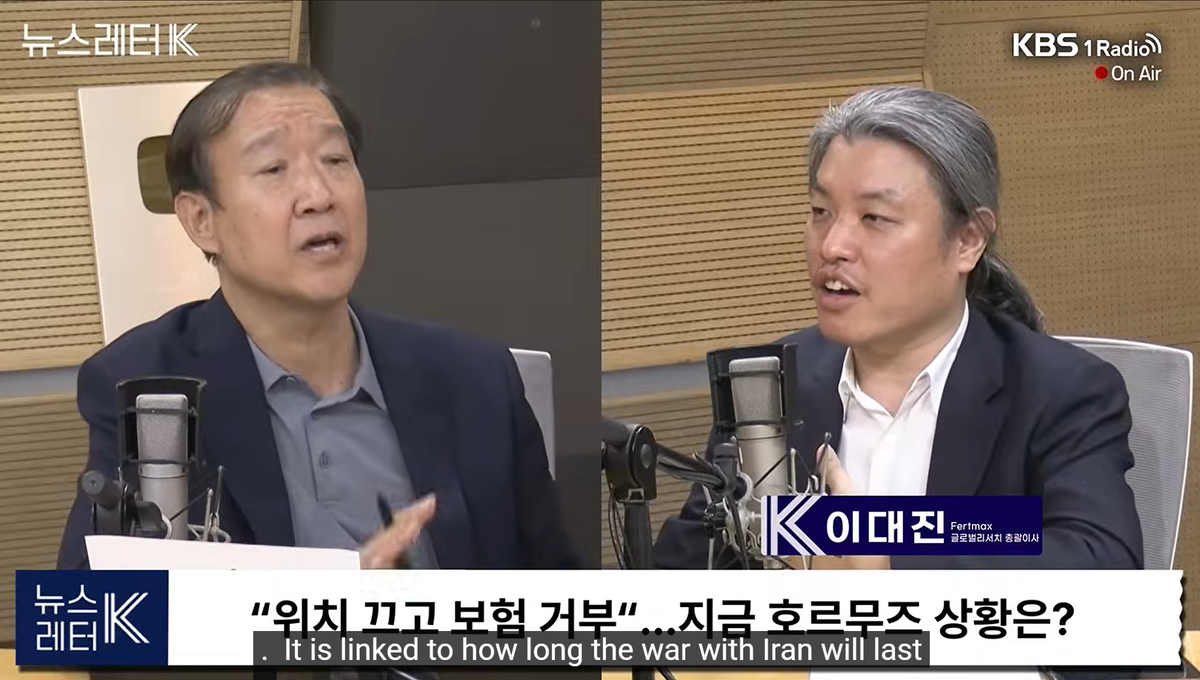
[HIGHLIGHT in ENGLISH, #KBS Newsletter K Broadcast (Aug 19, 2026)]
“How long will the Iran war last?” Developing your own view on that question can be extremely useful when planning what comes next. So below, I explain my current view—and, more importantly, the assumptions behind it.
1. Iran’s new Supreme Leader, Mojtaba Khamenei, has yet to appear publicly.
Rumours continue about his health and even whether he is still alive, while the IRGC’s consolidation of power still appears incomplete. For a leadership trying to tighten its grip internally, an external war can remain a politically useful asset.
2. For President Trump, there may be limited incentive to rush toward ending the war while oil remains around $70–100/bbl.
U.S. energy companies—an important political constituency—are benefiting from opportunities to replace disrupted supply. At the same time, ending the conflict without resolving the nuclear issue could create political costs among strongly pro-Israel supporters.
3. China may ultimately be one of the biggest economic losers.
China has long benefited from heavily discounted commodities from Iran, Venezuela and Russia, helping support the competitiveness of its manufacturing sector. A series of developments this year has significantly reduced that advantage.
4. GCC countries continue to invest billions of dollars in pipelines and infrastructure designed to bypass the Strait of Hormuz.
Even if the Strait reopens before the U.S. midterm elections, they are clearly not assuming that it will simply remain open indefinitely.
5. In one or two years, as more bypass infrastructure becomes operational, the strategic leverage of the Strait of Hormuz could weaken considerably.
6. Prolonged instability creates both exits and entry opportunities.
Some companies will withdraw from the region. Others may see this as an opportunity to acquire networks, infrastructure and market positions at attractive valuations.
7. Therefore, this winter is both a crisis and an opportunity.
If we assume that the disruption will continue for some time—but not forever—then the priority is to build enough resilience to survive the winter, while also preparing to invest or lock in gains when signs of de-escalation begin to emerge, potentially sometime next year.
8. What signals could indicate that the war is approaching an end—or at least a meaningful de-escalation?
- Iran: Signs that the internal power struggle has been resolved—for example, Mojtaba appearing publicly, or alternatively the removal or weakening of elected and negotiation-oriented political forces.
- The U.S. and Israel: A shift from maximum pressure toward engagement. One possible path would be a ceasefire accompanied by large-scale sanctions relief, reconstruction funding or financial incentives designed to weaken the IRGC’s justification for maintaining extraordinary wartime power, while strengthening elected or negotiation-oriented factions.
- Or, perhaps, another war begins elsewhere.
9. The U.S. may prefer a ceasefire before the November midterm elections. Iran, too, eventually faces physical constraints as oil storage capacity fills.
But even if Iranian exports resume and the U.S. election passes, many of the underlying causes of the conflict will remain unresolved—meaning the conditions for renewed confrontation could still be there.
10. There are simply too many unknowns—including unknowns we do not even know exist.
The future will always be a realm of fear and humility. But that does not mean we can give up on prediction.
— The Art of Prediction (Banni Publishing)
Wishing everyone good fortune in navigating what comes next.
영어더빙을보고 충격도 받았지만 오디세우스 닮았다는 응원에 힘을 받았네요. 아래는 영상 중 26:06에 잠시 설명드린 내용입니다.
결국에는 '이란 전쟁 언제까지 갈까?' 에 대해 진지하게 고민해 보시고 자신의 견해를 확립하는 것이 향후 계획 수립 하실 때 도움이 될 것으로 보고 있습니다.
그래서 아래 조금 더 자세한 의견과 추정 근거를 설명 드립니다. 자신의 견해가 맞는 것이 중요한 것이 아니라 상황이 벌어졌을때 빠르게 대응하여 성공적인 결과를 내는 것이 핵심이므로 자신만의 뷰를 수립하고 그 배경이 되는 근거를 수립하는것에 도움이 되었으면 좋겠습니다.
[스페셜분석] 호르무즈해협, 이번 겨울이 위기이자 기회이다.
1. 이란 새 최고지도자 모즈타파가 공식 석상에 나타나지 않는다. 위독설과 사망설이 돌고, 혁명수비대의 권력 장악은 미완성으로 보인다. 내부 권력을 다지는 중인 지도부에게 외부의 전쟁은 유지할수록 유리한 자산이다.
2. 미국 트럼프 대통령은 유가가 70-100불 수준에서는 자신의 후원 이익집단인 에너지기업들이 대체 수출을 하며 돈을 쓸어담는중으로 나쁠것이없고 핵문제를 해결 못 한상태에서 전쟁을 끝내기에는 유대계 후원자들이 등응 돌릴 수 있는 부담이 크다.
3. 가장 큰 피해자는 결국 값싼 원유를 공급 못받는 중국이다. 중국은 이란 베네주엘라 러시아산 원자재를 크게 할인된 가격에 공급받으면서 제조업 경쟁력을.유지했는데 올해 일련의 사건들로 그 이점을 크게 상실함.
4.GCC국가들은 수십억 달러짜리 호르무즈.우회 파이프라인 투자를 지속한다..중간선거전 호르무즈 해협이 열려도, 계속 열려 있으리라 가정하지 않는다.
5. 우회파이프라인들이 완성돠는 1-2년 시점에는 호르무즈해협의 레버리지는 크게 약화된다.
6. 장기화되며 철수하는 기업들이 존재하는 동시에 오히려 이번 기회에 네트워크 인프라를 싸게 확보하는 투자히려는 곳들도 있다.
7. 따라서 이번 겨울이 위기이자 기회의 시점이다. 당분간 지속되겠지만 영원히 지속되지 않는다고 가정한다면 겨울을 버틸 힘을 쌓되 긴장완화가 되는 시점이 내년즈음에는 올수있다고 보고 투자나 이익확정을 노려야 한다.
8. 전쟁종료 혹은 완화신호는 아래와 같다.+ 이란쪽 권력투쟁완료 신호, 즉 모즈타파의 등장 혹은 대통령 의회등 산출권력 - 협상파의 퇴진+ 미국 이스라엘쪽 신호, 강경책보다 햇볕정책으로의 전환. 휴전과 동시에 대대적 자금 해제와 재건기금 제공으로 군의 권력장악 명분약화 시도. 선출권력 협상파 명분강화+또 다른 전쟁 시작...
9. 미국 11월 중간선거전 휴전 원함. 이란 역시 유전 탱크 포화시점이 온다. 하지만 이란이 원유수출이 완료되고 미국 역시 선거 끝나면 또 재개될 요인이 여전히 해결되지 않고 있음
10. 미래는 우리가 모른다는 사실조차 모르는 미지수들이 너무 많기에, 미래는 언제나 두려움과 겸손의 영역이다. 하지만 그렇다고 예측을 포기할 수는 없다. - 예측의기술 (반니출판)
모두에게 무운을 빕니다.
감사합니다.