Special Analysis: Why the Strait of Hormuz Must Be Read in a Larger Picture
I joined Gulf Intelligence's Daily Energy Markets podcast today. Grateful for the invitation Sean Killian Evers Medilyn Singh Stephanie Gatdula and for the sharp exchange with my fellow panelists. Bill Spindle Bora Bariman Rustin Edwards
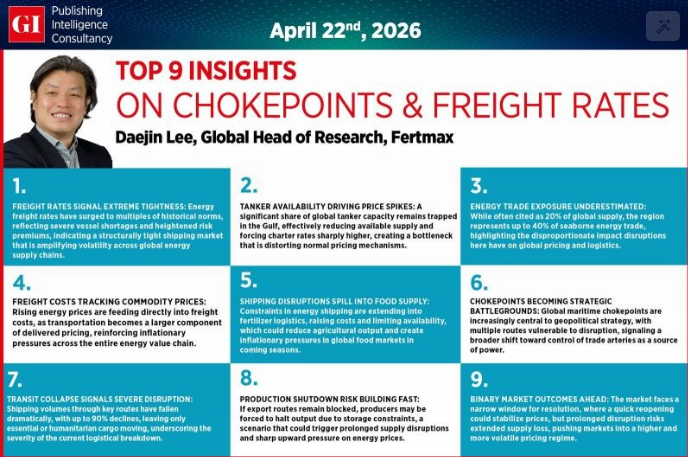
Another ceasefire extension. AIS traffic says limited as usual.
My view on the Strait of Hormuz in a broader context — and why it matters more now: energy is becoming the new labor.

Most of the commentary you’ll read right now is focused on ceasefires, nuclear frameworks, and regime dynamics. From where I sit, that framing is too narrow. Hormuz is one chokepoint — but there are several others, and they belong to the same system.

When we discuss the Strait of Hormuz, it is often treated as a singular event. It isn’t. The Strait of Malacca, Bosporus, Suez Canal, Gibraltar, and the Panama Canal are all part of the same map. Each is a pinch point in global trade, and in nearly every case the United States has a direct interest or presence — whether through naval power, commercial infrastructure, or strategic leverage.

That is the backdrop worth holding in mind. Even though the current conversation is centered on Hormuz, we may soon be having the same conversation about another corridor. At its core, this is a question of who controls the arteries of global trade.

The 5–7% question: what happens if the next episode is also about energy?  (Full analysis below)
Special Analysis: Why the Strait of Hormuz Must Be Read in a Larger Picture — The Next Energy Chokepoint Closure May Already Be Coming
Most of the commentary you’ll read right now is focused on ceasefires, nuclear frameworks, and regime dynamics. From where I sit, that framing is too narrow. Hormuz is one chokepoint but there are several others, and they belong to the same system.
When we discuss the Strait of Hormuz, it is often treated as a singular event. It isn’t. The Strait of Malacca, Bosporus, Suez Canal, Gibraltar, and the Panama Canal are all part of the same map. Each is a pinch point in global trade, and in nearly every case the United States has a direct interest or presence — whether through naval power, commercial infrastructure, or strategic leverage.
That is the backdrop worth holding in mind. Even though the current conversation is centered on Hormuz, we may soon be having the same conversation about another corridor. At its core, this is a question of who controls the arteries of global trade.
The 5–7% question: what happens if the next episode is also about energy?
Roughly 5% of global seaborne oil trade moves through the Bosporus. Another 6–7% transits the Suez Canal, and about 3% through the Panama Canal. The Strait of Malacca is larger still at around 29%, though unlike the others it has practical alternative routing via Lombok and Sunda.
Today, the flashpoint is Hormuz. But if a comparable disruption were to develop around the Bosporus, the Red Sea approaches, or the Singapore/Malacca corridor, the cumulative impact on seaborne energy trade would be materially larger than any single-chokepoint analysis suggests.
The vulnerability of the system is not concentrated in any one strait — it lies in the fact that multiple chokepoints are increasingly being used, or perceived, as instruments of policy at the same time.
Why this matters more now: energy is becoming the new labor
There is a longer-term shift that reframes the discussion. Energy is now tightly linked to AI, and AI is increasingly substituting for human labor. Extend that trajectory over the next 10–20 years, and controlling energy begins to look very much like controlling productive capacity in the global economy.
That changes the strategic meaning of a chokepoint. A strait is no longer just a shipping route — it is a lever over the fuel of the next economy. The “friction” we are seeing in Hormuz today is, in that sense, a contest over the labor of the 21st century.
The 90% reality
Back to the present. Under normal conditions, roughly 120 vessels transit the Strait of Hormuz each day, about half of them energy-related. Current traffic is running at 10 to 20 — roughly a 90% reduction. What little is moving is weighted toward food and high-priority humanitarian cargo.
This matters for how we interpret the word “ceasefire.” Headlines suggest normalization. The AIS data suggests the energy corridor is operating at roughly 10% of its normal capacity. These are two very different realities — and markets, particularly freight, insurance, and refining, are responding to the latter, not the former.
The takeaway
Hormuz is not the story by itself. It is the current expression of a broader pattern: strategic chokepoints becoming the stage on which energy — and, by extension, the productive capacity of the AI era — is contested.
Watching only Hormuz risks missing what the map is actually telling us.

Episode Description
Trump’s indefinite ceasefire masks unresolved tensions, with Bill Spindle expecting a JCPOA-style framework but warning conflict could resume. Rustin Edwards highlights soaring freight costs squeezing refining margins. Bora Bariman sees prolonged economic fallout and geopolitical fragmentation. Daejin Lee stresses constrained shipping capacity and risks to energy and food supply chains if disruptions persist.
https://www.youtube.com/watch?v=bHu1R2f6-2s&t=1285s
https://www.linkedin.com/video/live/urn:li:ugcPost:7452604779001765888/